Moon phases for kids: why does the Moon change shape?
One night the Moon is a thin curve, a week later it is a half circle, and two weeks later it is a bright full circle. Does the Moon really change shape? No. The Moon is always a ball. What changes is how much of its lit side we can see from Earth.
The Moon does not make its own light
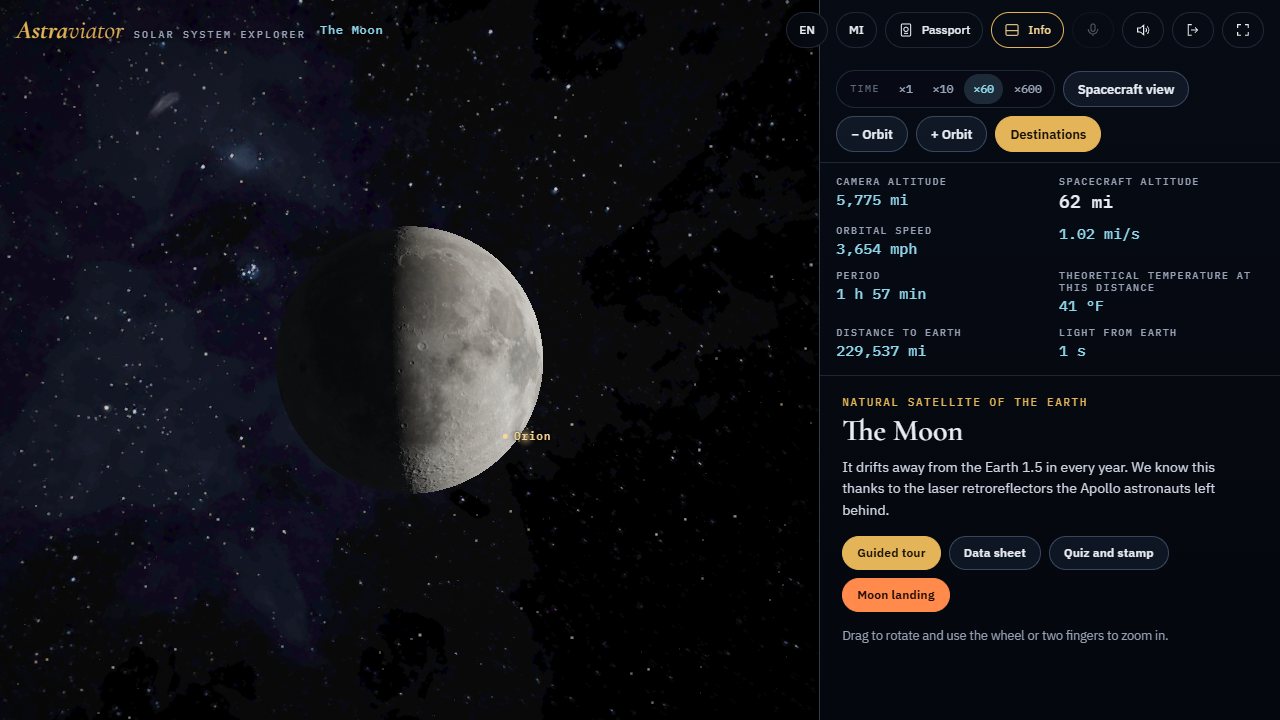
The Moon is a big ball of rock, about 2,159 miles (3,474 km) across. It does not shine by itself. We see it because it reflects sunlight, just like a ball in a sunny garden. At any moment the Sun lights up exactly half of the Moon, the half facing the Sun.
Why we see different phases
The Moon travels around the Earth once about every 27 days, at an average distance of about 239,000 miles (384,000 km). As it moves, the angle between the Sun, the Earth and the Moon keeps changing. So from our spot on Earth we see more or less of the lit half.
- When the Moon is on the same side of Earth as the Sun, its lit side faces away from us. We see (almost) nothing: that is the New Moon.
- When the Moon is on the far side of Earth from the Sun, we see the whole lit side: the Full Moon.
- In between, we see part of the lit half, and the shape slowly grows or shrinks.
The full cycle, from one New Moon to the next, takes about 29.5 days. That is a little longer than the 27-day orbit because the Earth is also moving around the Sun, so the Moon needs two extra days to line up again. This is where the word “month” comes from.
The 8 phases of the Moon
The pictures show the Moon as seen from the Northern Hemisphere. In the Southern Hemisphere the lit part is on the opposite side.
Waxing means the lit part is growing, from New Moon toward Full Moon. Waning means it is shrinking. A crescent is less than half lit, a gibbous Moon is more than half lit, and at the quarter phases we see half of the Moon’s face lit (one quarter of the whole Moon’s surface).
A trick to remember waxing and waning
In the Northern Hemisphere, think of the letters D-O-C. A waxing Moon, getting bigger, looks like a D. The Full Moon is an O. A waning Moon, getting smaller, looks like a C.
Are moon phases caused by the Earth’s shadow?
Many people think moon phases come from the Earth’s shadow covering the Moon. That is a very common mistake. The Earth’s shadow only touches the Moon during a lunar eclipse, which is rare and happens only at Full Moon. Normal phases are just the Moon’s own lit half seen from different angles.
Why we always see the same face
The Moon spins once for every trip around the Earth, so the same side always faces us. The other side is called the far side, not the “dark side”: it gets just as much sunlight as the side we see, we simply never see it from Earth.
Try it at home
What you need
- A dark room with one lamp (no shade) at one side
- A ball or an orange on a pencil or stick
- A friend or a mirror to play “Earth”
Steps
- Put the lamp on a table at the edge of the room. The lamp is the Sun. Turn off the other lights.
- Hold the ball at arm’s length, just above your head. Your head is the Earth and the ball is the Moon.
- Turn slowly in a circle, keeping the ball in front of you. Watch how much of the ball is lit when it is toward the lamp, to your side and away from the lamp.
- Stop at 8 positions around the circle and match what you see with the 8 phases above.
- Bonus: look at the real Moon each evening for two weeks and draw it in your notebook.
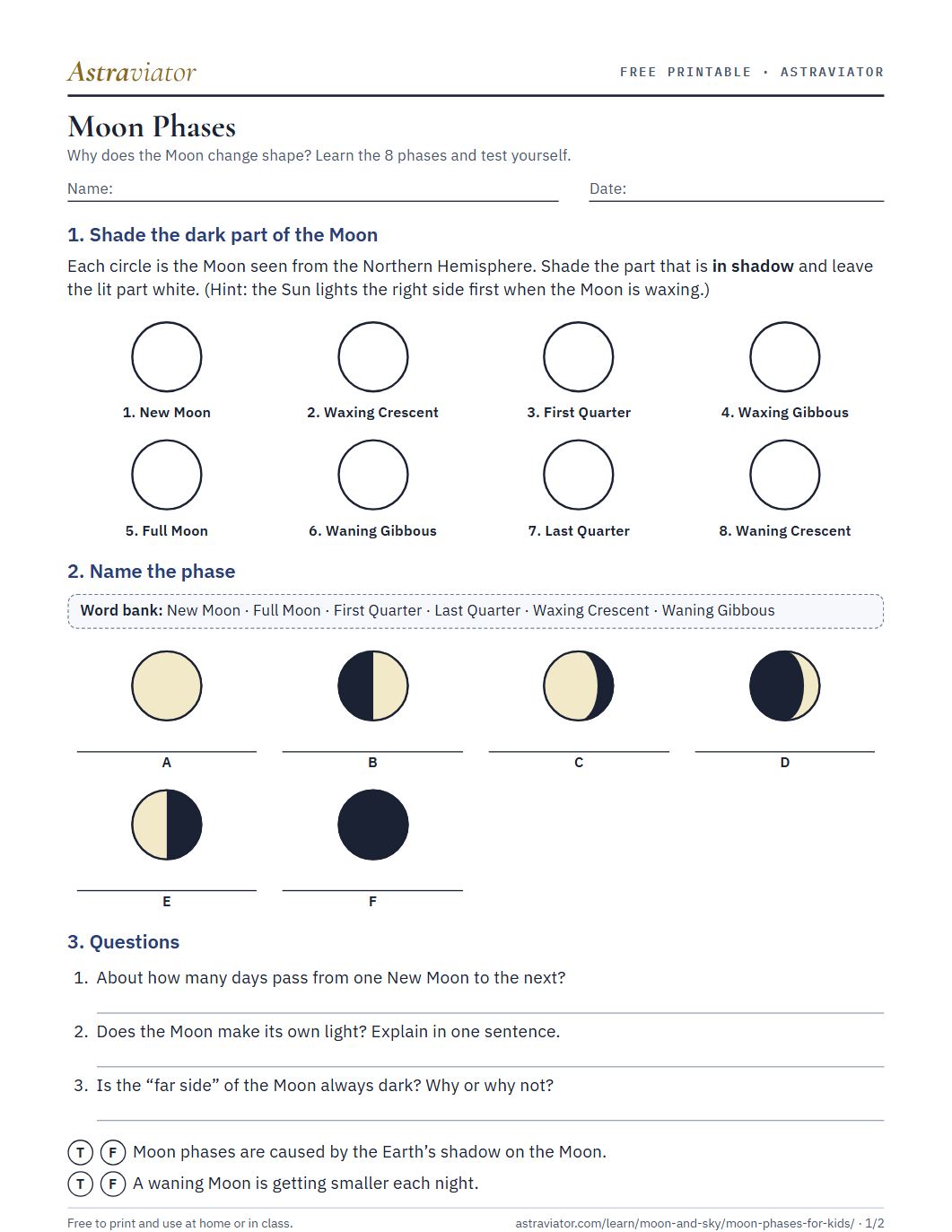
Free printable worksheet: Moon Phases
Print it, solve it, check it with the answer key on page 2. No sign-up, no email needed.
Download the worksheet (PDF)PDF, 2 pages (worksheet + answer key), US Letter size.
Quick answers
How long does it take the Moon to go through all its phases?
About 29.5 days from one New Moon to the next.
Why can I sometimes see the Moon in the daytime?
The Moon is above the horizon for part of the day too. It is bright enough to see against the blue sky, especially around the quarter phases.
Is the dark part of the Moon the Earth’s shadow?
No. The dark part is simply the half of the Moon that is not facing the Sun. Earth’s shadow only causes lunar eclipses.
Do people in Australia see the same phases?
Yes, but upside down compared with the Northern Hemisphere, so a waxing Moon is lit on its left side.