How does a rocket work?
A rocket does not push against the ground or against the air. It throws hot gas down very fast, and the gas pushes the rocket up. That is why rockets also work in empty space, where there is nothing to push against.
Newton’s third law: action and reaction
More than 300 years ago, Isaac Newton described a rule of nature: for every action, there is an equal and opposite reaction. When you push a wall while wearing roller skates, you roll backward. When a balloon lets out air, the air goes one way and the balloon goes the other way.
A rocket engine is the same idea with a lot more power. Fuel and oxygen burn in a chamber and create very hot gas. The gas shoots out of a bell-shaped nozzle at several times the speed of sound. The push of the gas going down is the thrust that lifts the rocket up.
Why does a rocket work in space?
A common myth says the rocket pushes against the air. It does not. A rocket carries its own fuel and its own oxygen (called an oxidizer), so it can burn fuel even where there is no air. In fact, rockets work even better in space, because there is no air slowing them down.
Parts of a rocket
- Payload or capsule: what the rocket is carrying, like satellites or the crew.
- Propellant tanks: most of a rocket is fuel tank! About 90% of a rocket’s weight at liftoff is fuel and oxidizer.
- Engines: burn the propellant and make thrust.
- Guidance and controls: computers and tiny steering movements keep the rocket on course.
How much push is that?
NASA’s Space Launch System rocket, which sends the Orion capsule toward the Moon, makes about 8.8 million pounds of thrust at liftoff. To leave the ground, the thrust must be bigger than the rocket’s weight. Then the rocket speeds up, climbing faster every second.
Why do rockets have stages?
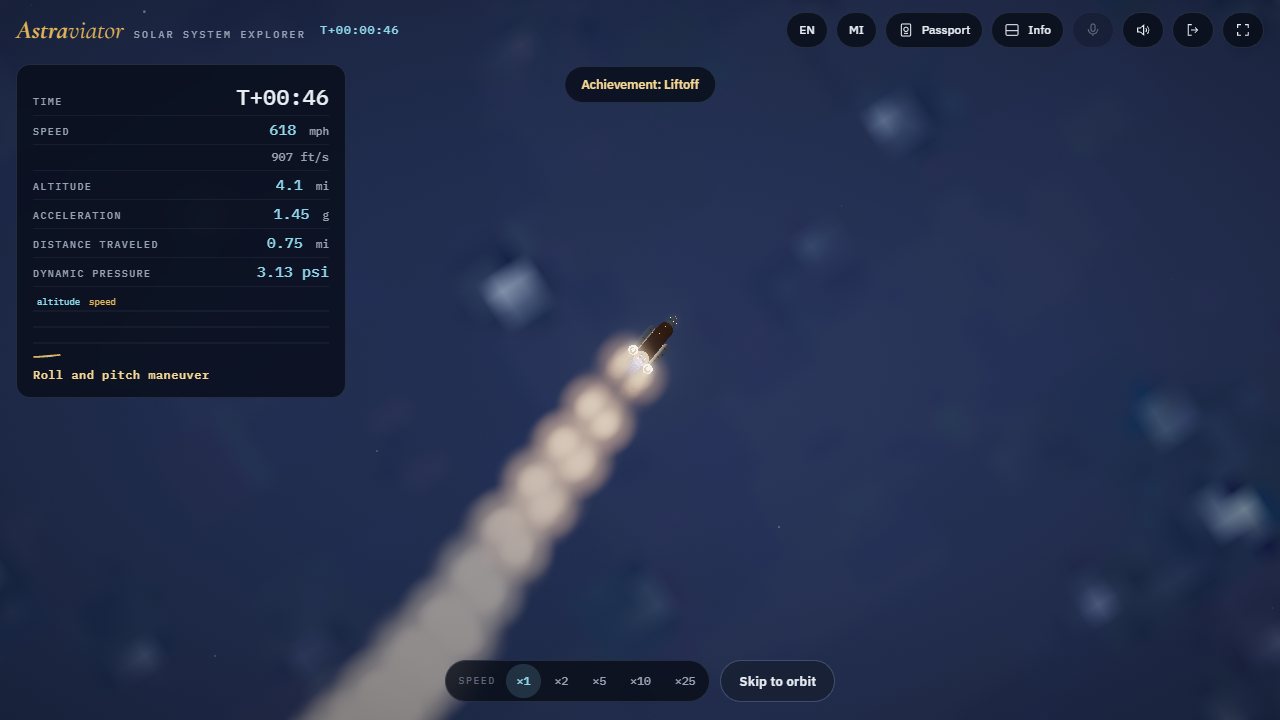
Once a tank is empty, it is just dead weight. So many rockets are built in pieces called stages. When the first stage runs out of fuel, it drops away, and the next stage keeps going with a lighter load. On SLS, the two side boosters separate about two minutes after liftoff.
How fast must a rocket go?
To stay in orbit around Earth, a spacecraft needs to travel about 17,500 miles per hour. Going straight up is not enough: the secret of orbit is speed sideways. The rocket slowly tips over after liftoff to build up that sideways speed. To reach the Moon, spacecraft fire their engine again in orbit to speed up even more.
Try it at home
What you need
- A long balloon
- A drinking straw
- About 10 feet (3 m) of string or fishing line
- Tape
- Two chairs
Steps
- Thread the string through the straw. Tie the string between two chairs so it is tight and level.
- Blow up the balloon (do not tie it). Pinch the opening and tape the balloon to the straw.
- Pull the balloon to one end, count down 3-2-1 and let go.
- Measure how far it travels. Try again with a bigger or smaller balloon and compare. Which one goes farthest?
- Explain: which way did the air go, and which way did the balloon go?
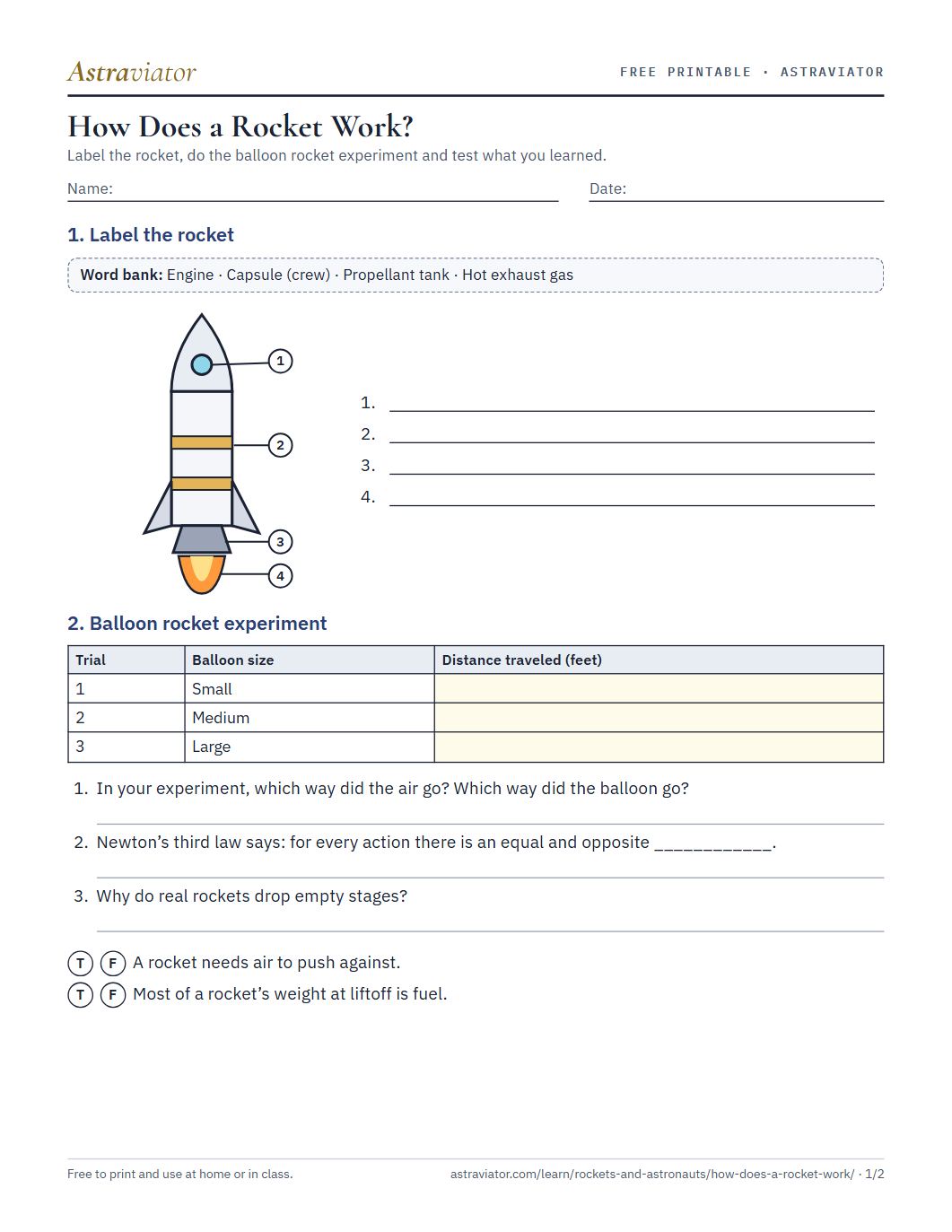
Free printable worksheet: How Does a Rocket Work?
Print it, solve it, check it with the answer key on page 2. No sign-up, no email needed.
Download the worksheet (PDF)PDF, 2 pages (worksheet + answer key), US Letter size.
Quick answers
What makes a rocket go up?
Hot gas shooting out of the engines pushes the rocket in the opposite direction. This push is called thrust.
Do rockets need air to fly?
No. Rockets carry their own fuel and oxygen, so they work in the vacuum of space.
Why do rockets have more than one stage?
Dropping empty tanks makes the rocket lighter so the rest can go faster.
How fast does a rocket have to go to orbit Earth?
About 17,500 miles per hour (28,000 km/h).