Why do we have day and night, and the seasons?
Why is it dark at night? Why is it hot in summer and cold in winter? Two simple ideas explain it all: Earth spins like a top, and Earth is tilted.
Key facts
- Day and night happen because Earth spins once about every 24 hours.
- The Sun does not move across the sky: Earth turns.
- Seasons happen because Earth's axis is tilted by 23.5 degrees.
- It is not caused by distance: Earth is closest to the Sun in early January.
- When it is summer in the north, it is winter in the south.
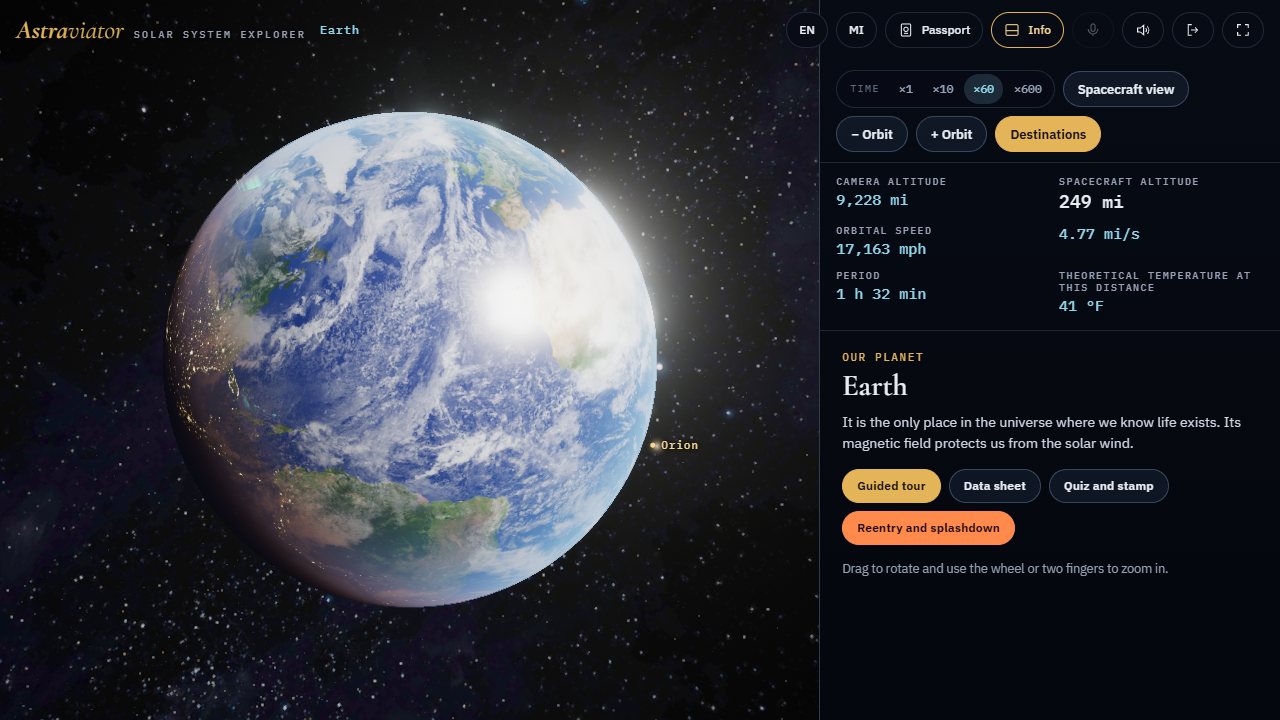
Day and night: Earth spins
Earth turns around an imaginary line through the North and South Poles, called its axis. It makes one full turn about every 24 hours. The side facing the Sun has day, and the side facing away has night. As Earth turns, the places on it move in and out of sunlight.
It looks as if the Sun moves across the sky, but it is really us who are moving. At the equator, the ground moves at about 1,000 miles per hour (1,670 km/h), but we do not feel it, just as you do not feel a smooth car ride.
A year: Earth travels around the Sun
At the same time, Earth moves around the Sun on a path called an orbit. One trip takes about 365 and a quarter days, which is one year. That extra quarter day is why we add one day every four years, the leap day.
Seasons: Earth is tilted
Earth’s axis is not straight up and down. It is tilted by 23.5 degrees, and it keeps pointing the same direction in space during the whole orbit. So for part of the year the Northern Hemisphere leans toward the Sun, and for another part it leans away.
- Summer: your hemisphere leans toward the Sun. Sunlight hits more directly, days are longer and it is warmer.
- Winter: your hemisphere leans away. Sunlight is spread out, days are shorter and it is colder.
- Spring and autumn: in between, with days and nights about equal around the equinoxes (about March 20 and September 22).
A very common mistake
Many people think summer happens because Earth is closer to the Sun. That is not true! Earth is actually closest to the Sun in early January, in the middle of Northern winter. Seasons are caused by the tilt, not by the distance.
Opposite seasons
When the Northern Hemisphere leans toward the Sun, the Southern Hemisphere leans away. So when it is summer in the United States or Spain, it is winter in Australia or Argentina. Near the poles, the tilt creates the midnight Sun in summer and weeks of darkness in winter.
Try it at home
What you need
- A flashlight
- A globe, or a ball with a sticker for your home
- A dark room
Steps
- Turn off the lights. The flashlight is the Sun. Light the globe from one side: that side has day and the other has night.
- Slowly spin the globe. Watch your sticker go from day to night and back.
- Now tilt the globe a little and carry it in a big circle around the flashlight, keeping the tilt pointing the same direction.
- Stop at four places. At which stop does the top half get the most direct light? That is summer in the north!
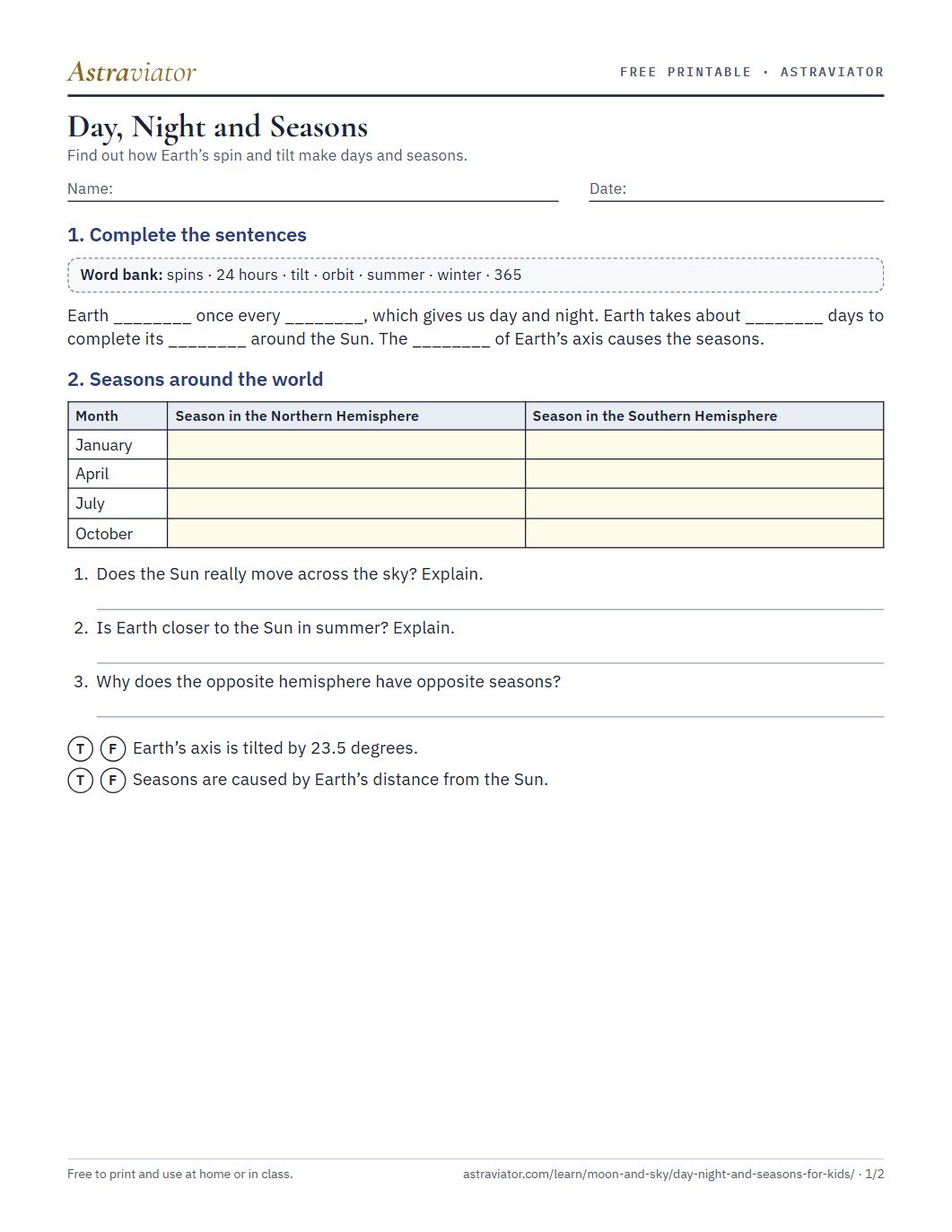
Free printable worksheet: Day, Night and Seasons
Print it, solve it, check it with the answer key on page 2. No sign-up, no email needed.
Download the worksheet (PDF)PDF, 2 pages (worksheet + answer key), US Letter size.
Quick answers
Why do we have day and night?
Because Earth spins once about every 24 hours, so each place turns toward the Sun and then away from it.
Why do we have seasons?
Because Earth's axis is tilted 23.5 degrees as it orbits the Sun.
Is summer when Earth is closest to the Sun?
No. Earth is closest to the Sun in early January. Seasons come from the tilt.
How long does it take Earth to go around the Sun?
About 365 and a quarter days.