What is a galaxy? The Milky Way for kids
The Sun is one star among hundreds of billions in a giant island of stars called a galaxy. Ours is the Milky Way, and it is only one of countless galaxies.
Key facts
- A galaxy is a huge group of stars, gas and dust held together by gravity.
- Our galaxy is called the Milky Way and has hundreds of billions of stars.
- The Milky Way is a spiral about 100,000 light-years across.
- The Sun is about 26,000 light-years from the center of the galaxy.
- The nearest big galaxy is Andromeda, about 2.5 million light-years away.
What is a galaxy?
A galaxy is a gigantic family of stars, gas, dust and planets, all held together by gravity. Some galaxies have millions of stars, others have trillions. Space between galaxies is mostly empty.
Our galaxy: the Milky Way
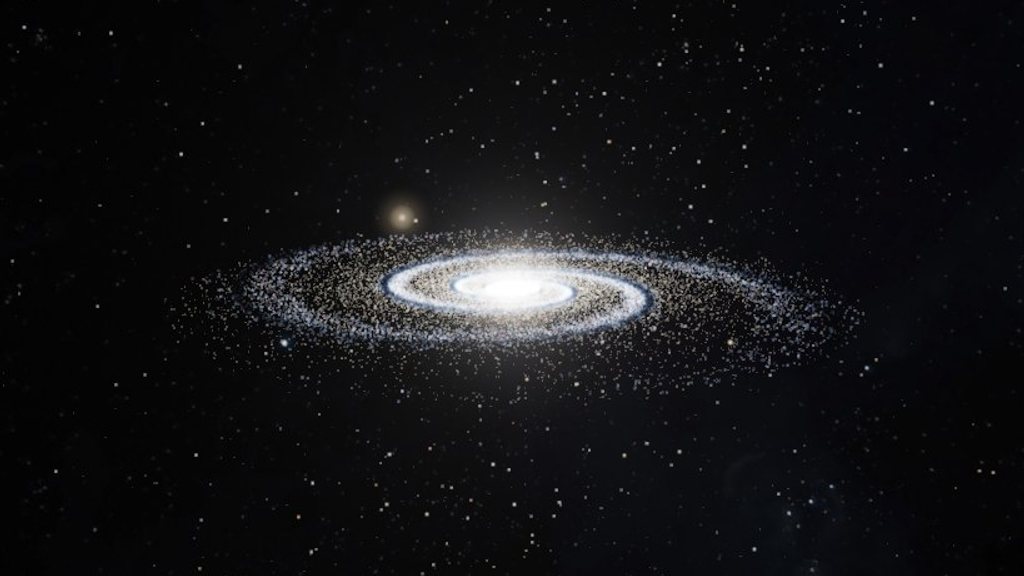
We live in the Milky Way. It has several hundred billion stars, and the Sun is just one of them. The Milky Way is shaped like a flat spinning disk with curved arms, a spiral galaxy, with a bright bulge in the center. From the side it would look like a fried egg.
The Sun lives about 26,000 light-years from the center, in one of the spiral arms. The Sun and the whole solar system circle the center of the galaxy once every 225 to 250 million years.
Why do we see a band of light in the sky?
Because we live inside the Milky Way disk, when we look along it on a clear dark night we see millions of faint stars together as a milky band. That is why it is called the Milky Way. You need a dark sky, far from city lights.
What is a light-year?
A light-year is a distance, not a time: how far light travels in one year, about 5.9 trillion miles (9.5 trillion km). Light needs 8 minutes to reach us from the Sun, but 4.2 years from the nearest other star, Proxima Centauri, so that star is 4.2 light-years away.
Types of galaxies
- Spiral: flat disk with arms, like the Milky Way.
- Elliptical: ball or oval shaped, with mostly older stars.
- Irregular: no regular shape.
Neighbors and the big picture
The nearest big galaxy is Andromeda, about 2.5 million light-years away. You can see it as a faint smudge on dark autumn nights in the Northern Hemisphere. Billions of years from now the two galaxies will collide and merge. Astronomers estimate there are hundreds of billions of galaxies in the part of the universe we can see.
Try it at home
What you need
- A dark bowl or plate
- Flour or salt
- A spoon
Steps
- Pour a thin layer of salt or flour on a dark tray.
- Put a spoon in the center and stir slowly in one direction.
- Watch the grains spread into curved arms, like a spiral galaxy.
- Place a small dot of different color on one arm: that is our Sun!
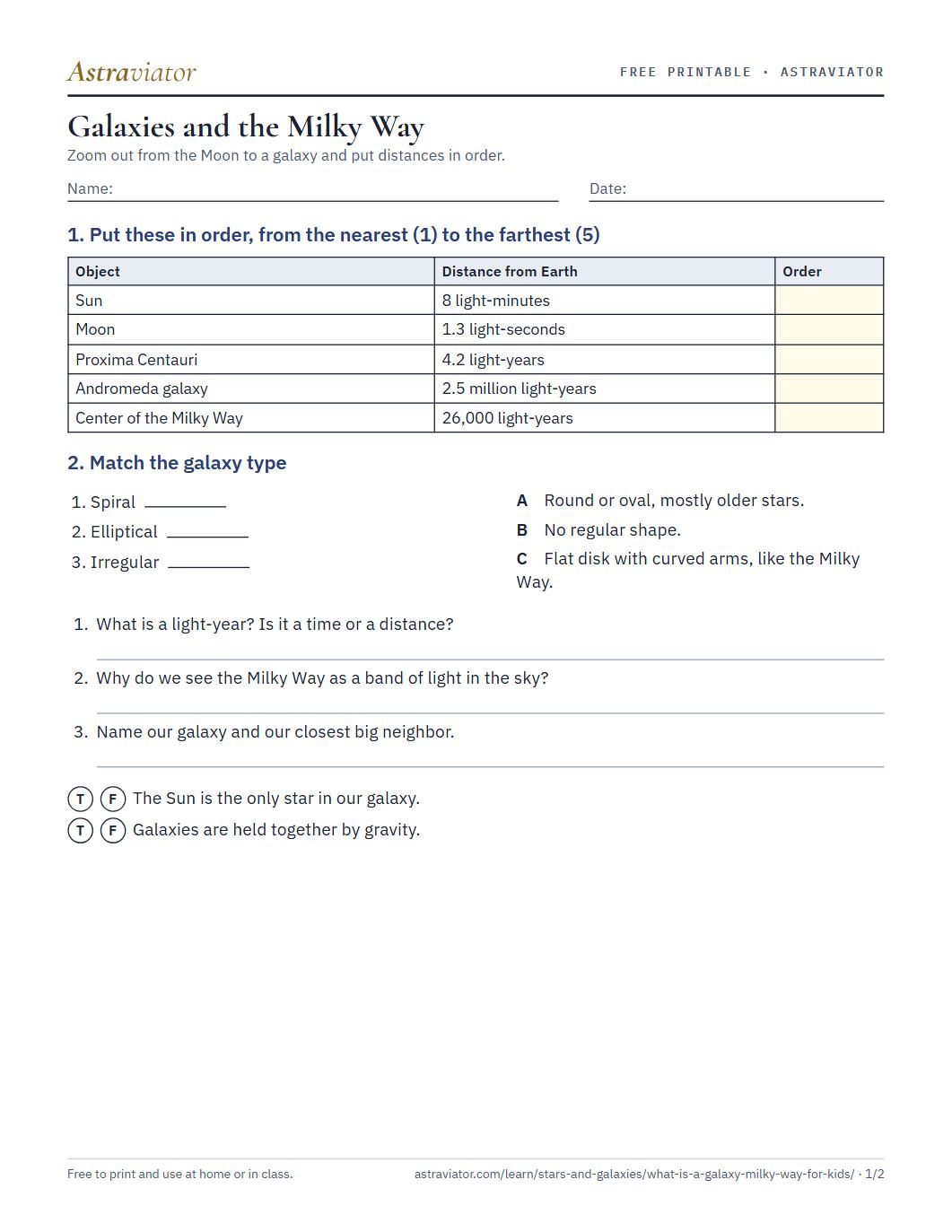
Free printable worksheet: Galaxies and the Milky Way
Print it, solve it, check it with the answer key on page 2. No sign-up, no email needed.
Download the worksheet (PDF)PDF, 2 pages (worksheet + answer key), US Letter size.
Quick answers
What is a galaxy?
A huge group of stars, gas and dust held together by gravity.
What galaxy do we live in?
The Milky Way.
How big is the Milky Way?
About 100,000 light-years across.
What is a light-year?
The distance light travels in one year, about 5.9 trillion miles.