The solar system for kids
Our solar system is our home in space. It is made of one star, the Sun, and everything that orbits it: planets, moons, asteroids and comets. Here is everything you need to know for a school project.
Key facts
- The solar system is the Sun and everything that travels around it.
- It has 8 planets: Mercury, Venus, Earth, Mars, Jupiter, Saturn, Uranus and Neptune.
- It formed about 4.6 billion years ago from a giant cloud of gas and dust.
- The Sun holds more than 99.8% of all the mass in the solar system.
- Besides planets there are moons, dwarf planets, asteroids and comets.
What is the solar system?
The solar system is the Sun and all the objects held by its gravity. Gravity is the invisible pull that keeps the planets traveling around the Sun in paths called orbits. Our solar system formed about 4.6 billion years ago, when a huge cloud of gas and dust collapsed. Most of the material fell into the center and became the Sun. The rest formed the planets and other objects.
The Sun: our star
The Sun is a star, a giant ball of hot gas that makes its own light and heat. It is so big that more than one million Earths could fit inside it. It holds over 99.8% of the mass of the whole solar system, which is why everything else orbits around it.
The 8 planets
A planet is a large round world that orbits a star and has cleared its path of other objects. There are two main groups:
- Rocky planets (inner): Mercury, Venus, Earth and Mars. They are small and have solid ground.
- Giant planets (outer): Jupiter and Saturn are gas giants, made mostly of hydrogen and helium. Uranus and Neptune are ice giants, with a lot of water, ammonia and methane in their depths.
| Planet | Type | Distance from the Sun | One year lasts |
|---|---|---|---|
| Mercury | Rocky | 36.0 million miles | 88 Earth days |
| Venus | Rocky | 67.2 million miles | 225 Earth days |
| Earth | Rocky | 93.0 million miles | 365 days |
| Mars | Rocky | 142 million miles | 687 Earth days |
| Jupiter | Gas giant | 484 million miles | 11.9 Earth years |
| Saturn | Gas giant | 891 million miles | 29.5 Earth years |
| Uranus | Ice giant | 1,784 million miles | 84 Earth years |
| Neptune | Ice giant | 2,793 million miles | 165 Earth years |
A “year” is the time a planet needs to go once around the Sun. Distances are averages.
What else is in the solar system?
- Moons: worlds that orbit planets. Earth has one, Mars has two, and Jupiter and Saturn have dozens each. Mercury and Venus have none.
- Dwarf planets: round like planets but smaller and they have not cleared their orbit. Pluto and Ceres are examples.
- Asteroids: rocky leftovers. Most are in the asteroid belt between Mars and Jupiter.
- Comets: balls of ice and dust that grow glowing tails when they come close to the Sun.
Remember the order
Use a sentence where each word starts with the planet’s first letter: My Very Educated Mother Just Served Us Nachos. Or invent your own!
How big is it?
Light from the Sun needs about 8 minutes to reach Earth and more than 4 hours to reach Neptune. Our solar system is huge, but it is a tiny dot in the Milky Way galaxy.
Try it at home
What you need
- A large sheet of paper or poster board
- Colored paper, markers or modeling clay
- Scissors and glue
Steps
- Draw the Sun on the left side of the poster.
- Cut or mold the eight planets. Use the size table in our planet-sizes lesson to make Jupiter and Saturn bigger than the rocky planets.
- Place them in order and write one fact under each planet.
- Add the asteroid belt between Mars and Jupiter using dots or small crumpled paper.
- Write your memory sentence at the bottom.
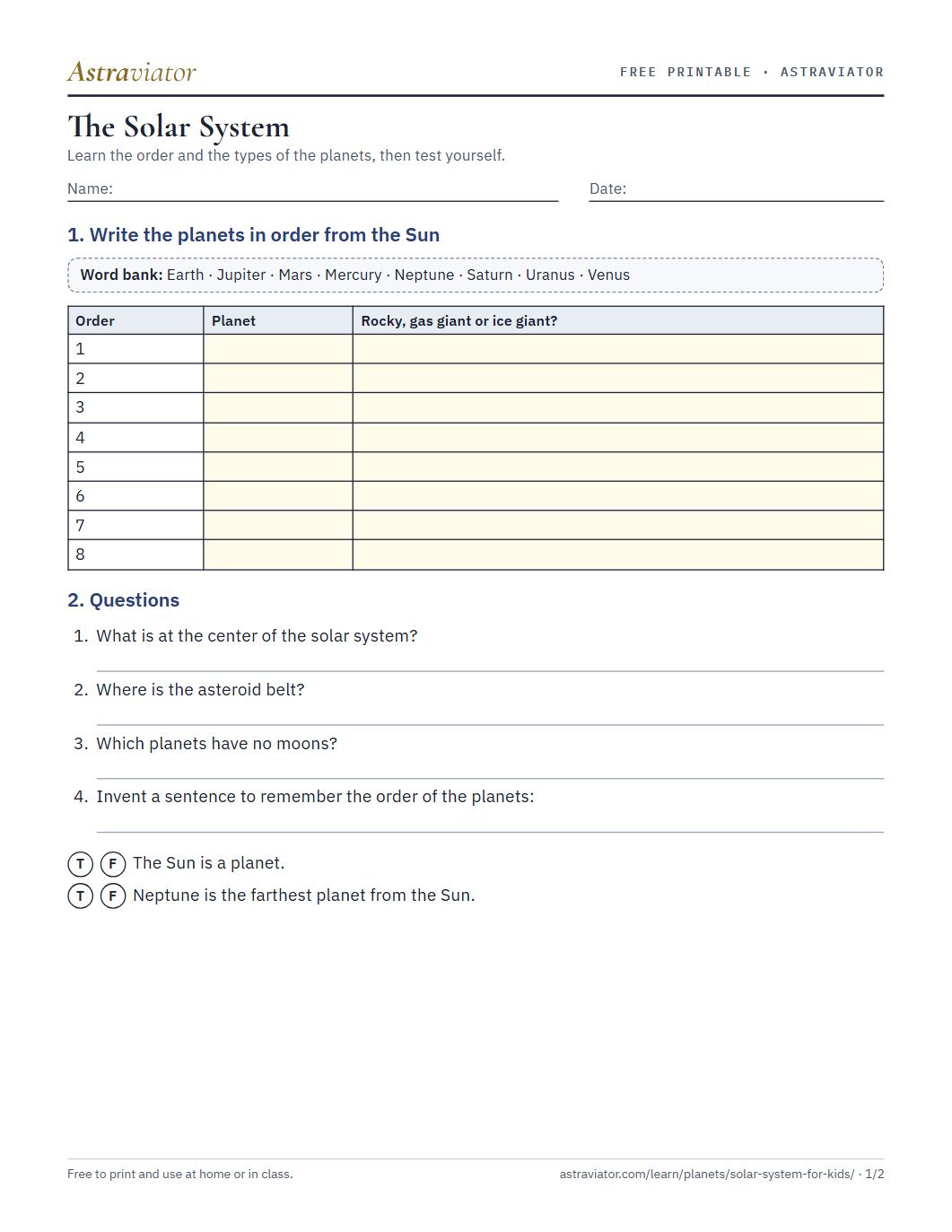
Free printable worksheet: The Solar System
Print it, solve it, check it with the answer key on page 2. No sign-up, no email needed.
Download the worksheet (PDF)PDF, 2 pages (worksheet + answer key), US Letter size.
Quick answers
How many planets are in the solar system?
Eight: Mercury, Venus, Earth, Mars, Jupiter, Saturn, Uranus and Neptune.
Is Pluto a planet?
Pluto is now called a dwarf planet. In 2006 astronomers decided that a planet must also have cleared its orbit of other objects, and Pluto has not.
What is at the center of the solar system?
The Sun, a star that holds most of the solar system’s mass.
How old is the solar system?
About 4.6 billion years.