How long does sunlight take to reach the planets?
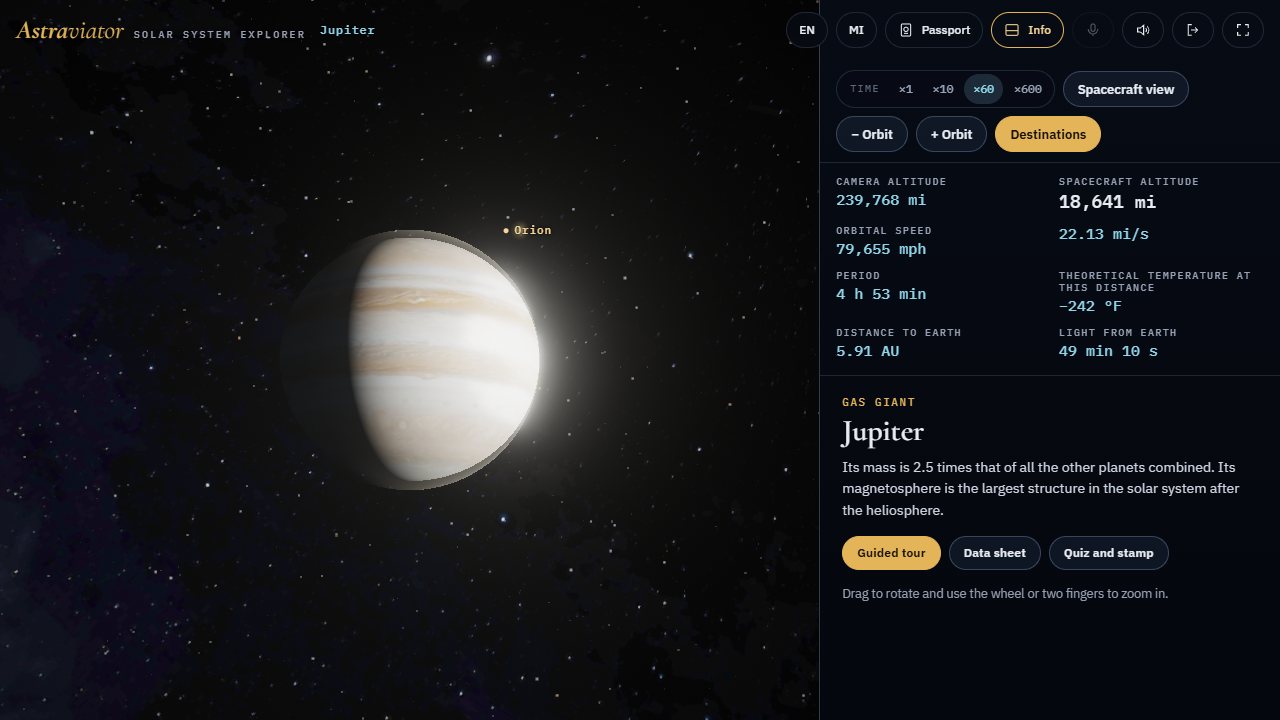
When you look at the Sun (never directly!), you are seeing light that left it about 8 minutes ago. Light is the fastest thing in the universe, but space is so big that even light needs minutes or hours to cross the solar system.
The speed of light
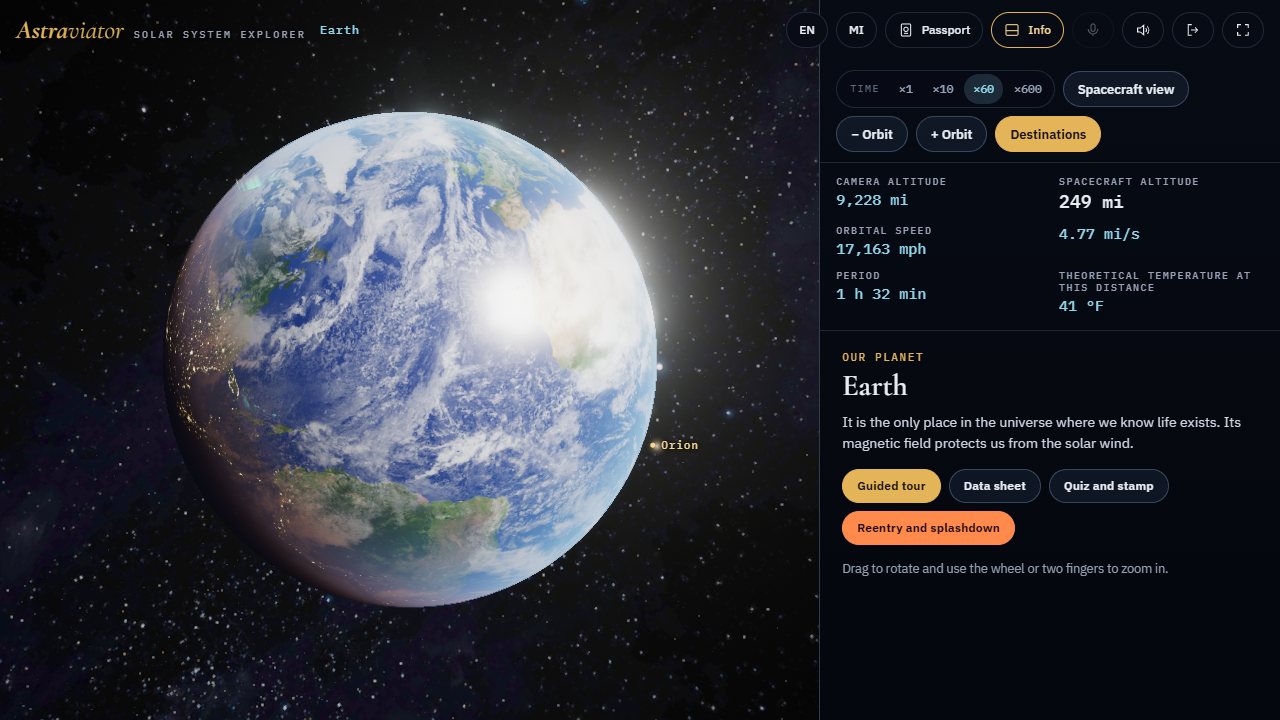
Light travels about 186,282 miles every second (299,792 km/s). In one second a beam of light could circle the Earth more than seven times. Nothing is known to go faster.
Because space is so wide, we measure distances in space with a handy trick: light-minutes and light-hours, meaning how long light needs to cross the gap. Light travels about 11 million miles in one minute.
Sunlight travel time to each planet
| Planet | Average distance from the Sun | Light travel time |
|---|---|---|
| Mercury | 36.0 million miles | 3 min 13 s |
| Venus | 67.2 million miles | 6 min 1 s |
| Earth | 93.0 million miles | 8 min 19 s |
| Mars | 142 million miles | 12 min 40 s |
| Jupiter | 484 million miles | 43 min 17 s |
| Saturn | 891 million miles | 79 min 43 s |
| Uranus | 1,784 million miles | 2 h 40 min |
| Neptune | 2,793 million miles | 4 h 10 min |
Distances are averages: planets move on slightly oval orbits, so the numbers change a little through the year.
What this means
- Earth: about 8 minutes 20 seconds. If the Sun disappeared, we would not notice for 8 minutes!
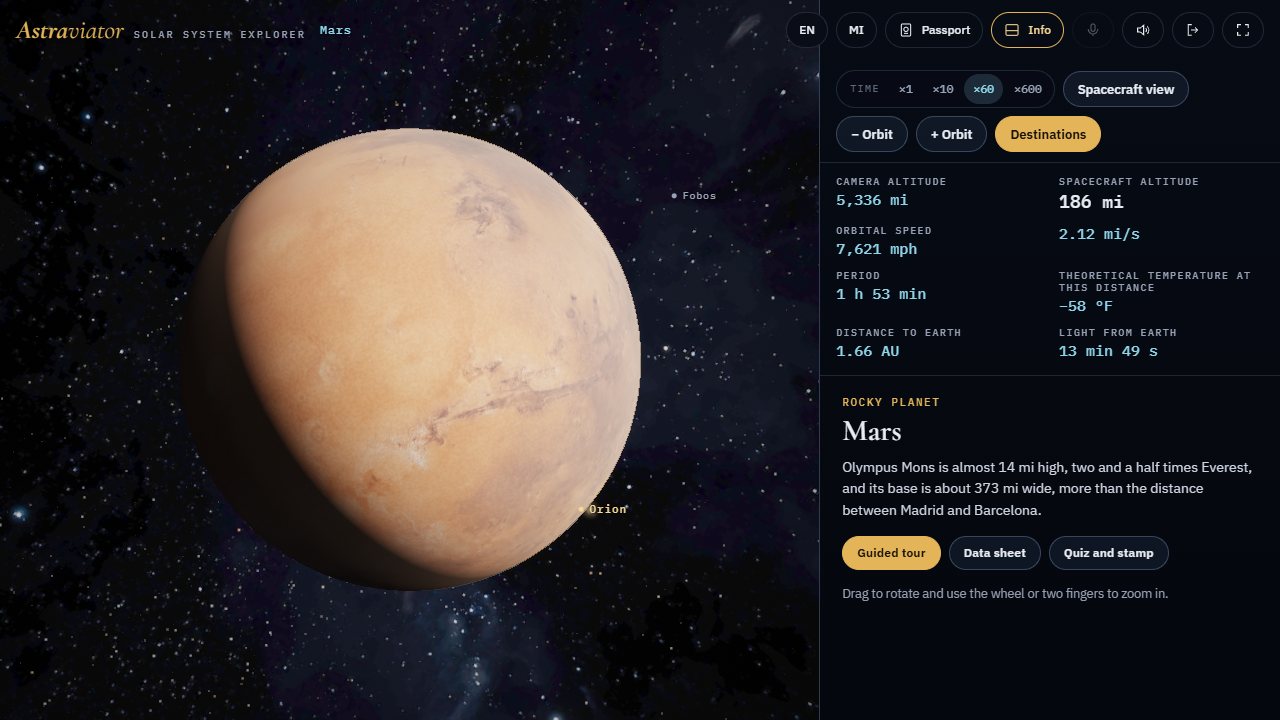
- Mars: about 12 minutes. A radio message from Earth to a Mars rover takes between 3 and 22 minutes depending on where the planets are, so rovers cannot be steered with a joystick. They drive themselves in small steps.
- Jupiter: about 43 minutes.
- Neptune: about 4 hours. Sunlight there is about 900 times dimmer than on Earth, yet still brighter than the full Moon.
Why signals to spacecraft are slow
Radio waves are a form of light, so they travel at the same speed. Voyager 1, the most distant spacecraft, is more than 15 billion miles away. A message sent to it needs over 20 hours to arrive, and the answer needs another 20 hours to come back. Engineers have to wait almost two days to learn whether a command worked.
Looking back in time
Light from far away objects takes even longer. The nearest star after the Sun, Proxima Centauri, is about 4.2 light-years away: the light we see tonight left it more than four years ago. When we look at space, we are looking back in time.
Try it at home
What you need
- A long hallway, yard or sidewalk (or a roll of toilet paper)
- Sticky notes or chalk
- A tape measure or your steps
Steps
- Pick a scale: 1 step = 1 light-minute (about 11 million miles). Put a note labeled “Sun” at the start.
- Walk 3 steps and mark Mercury; 6 steps for Venus; 8 steps for Earth; 13 steps for Mars.
- Keep going: Jupiter is 43 steps away, Saturn 80 steps. For Uranus (160) and Neptune (250) you may need to go to a park!
- Question: how many steps would it take to reach the nearest star on this scale? (Answer: about 2.2 million steps, over 1,000 miles of walking.)
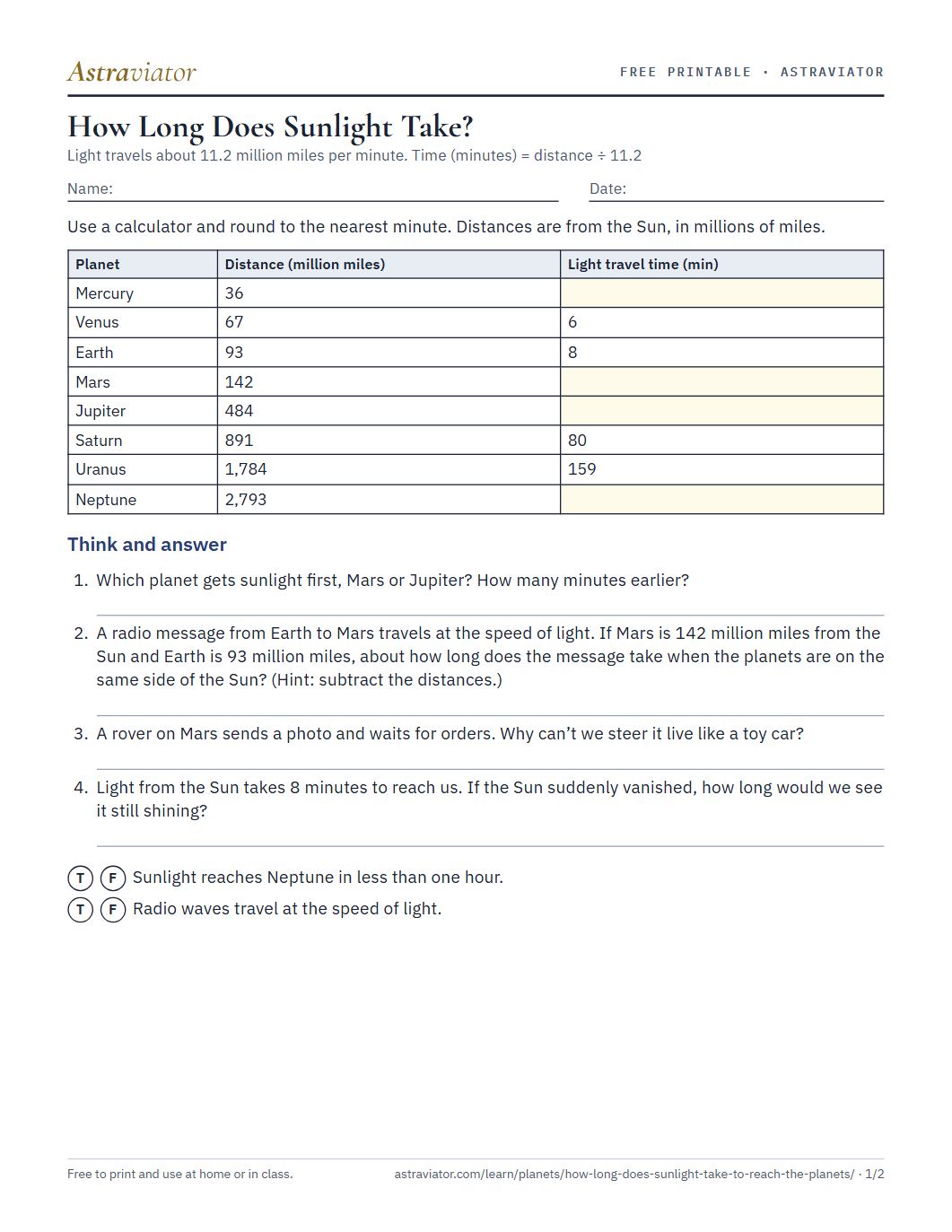
Free printable worksheet: How Long Does Sunlight Take?
Print it, solve it, check it with the answer key on page 2. No sign-up, no email needed.
Download the worksheet (PDF)PDF, 2 pages (worksheet + answer key), US Letter size.
Quick answers
How long does it take light to get from the Sun to Earth?
About 8 minutes and 20 seconds on average.
How fast is the speed of light?
About 186,282 miles (299,792 km) per second.
Why is Neptune so cold?
Because it is so far from the Sun. Its sunlight is only a tiny fraction of what Earth receives.
Is anything faster than light?
As far as scientists know, nothing can travel faster than light in empty space.