How much would you weigh on other planets?
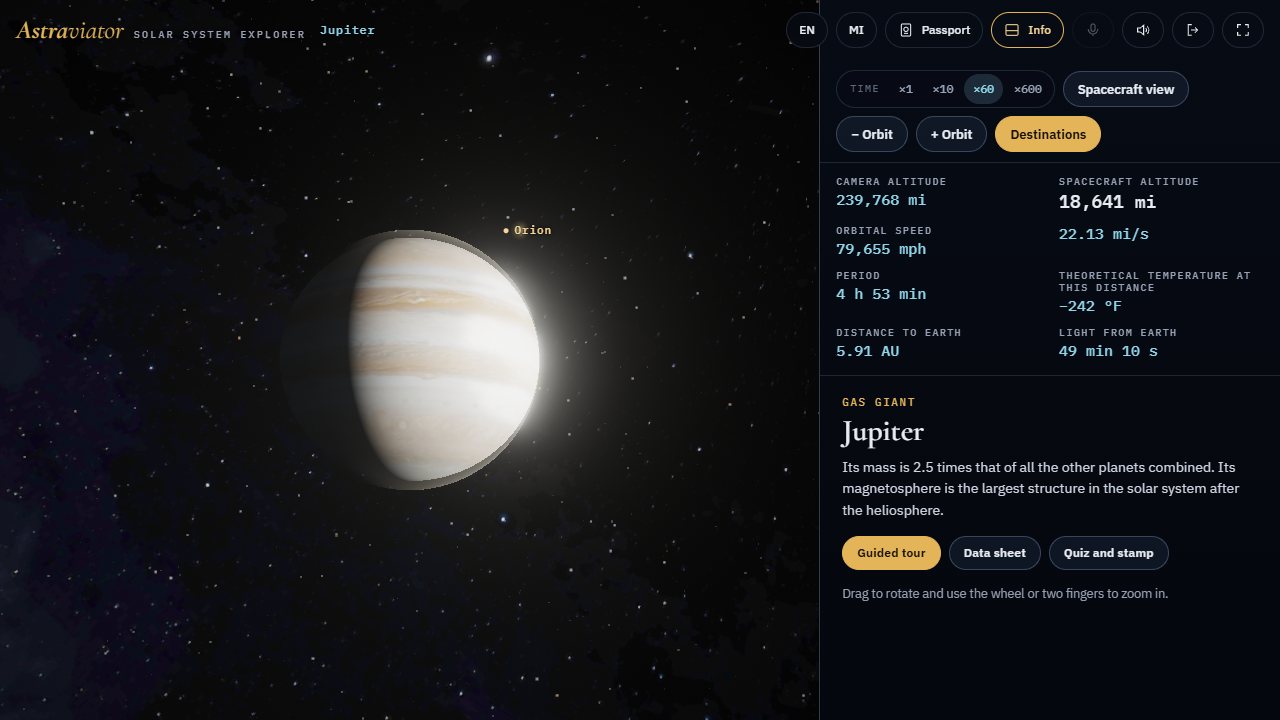
On the Moon you could jump much higher than on Earth. On Jupiter you would feel as if someone were carrying you on their back. The reason is gravity, and the same kid weighs a different amount on every planet.
Mass and weight are not the same
Mass is how much matter you are made of. It never changes, wherever you go. Weight is how hard gravity pulls on that mass, and that does change. The pull of a planet depends on how much mass the planet has and how far you are from its center. A bigger, heavier planet pulls harder.
The simple rule is: weight on a planet = your weight on Earth × the planet’s gravity number. The gravity number tells you how many times stronger or weaker the pull is compared with Earth (Earth = 1).
Gravity numbers for the Moon and the planets
| World | Gravity (Earth = 1) | If you weigh 60 lb on Earth |
|---|---|---|
| Moon | 0.17 | 10.2 lb |
| Mercury | 0.38 | 22.8 lb |
| Venus | 0.9 | 54.0 lb |
| Earth | 1 | 60.0 lb |
| Mars | 0.38 | 22.8 lb |
| Jupiter | 2.53 | 151.8 lb |
| Saturn | 1.07 | 64.2 lb |
| Uranus | 0.9 | 54.0 lb |
| Neptune | 1.14 | 68.4 lb |
For Jupiter, Saturn, Uranus and Neptune there is no solid ground, so the numbers are for the level of the cloud tops.
What does this feel like?
- Moon: about one sixth of Earth’s gravity. Apollo astronauts hopped and bounced in their heavy suits. A jump that reaches 1 foot on Earth could reach roughly 6 feet on the Moon.
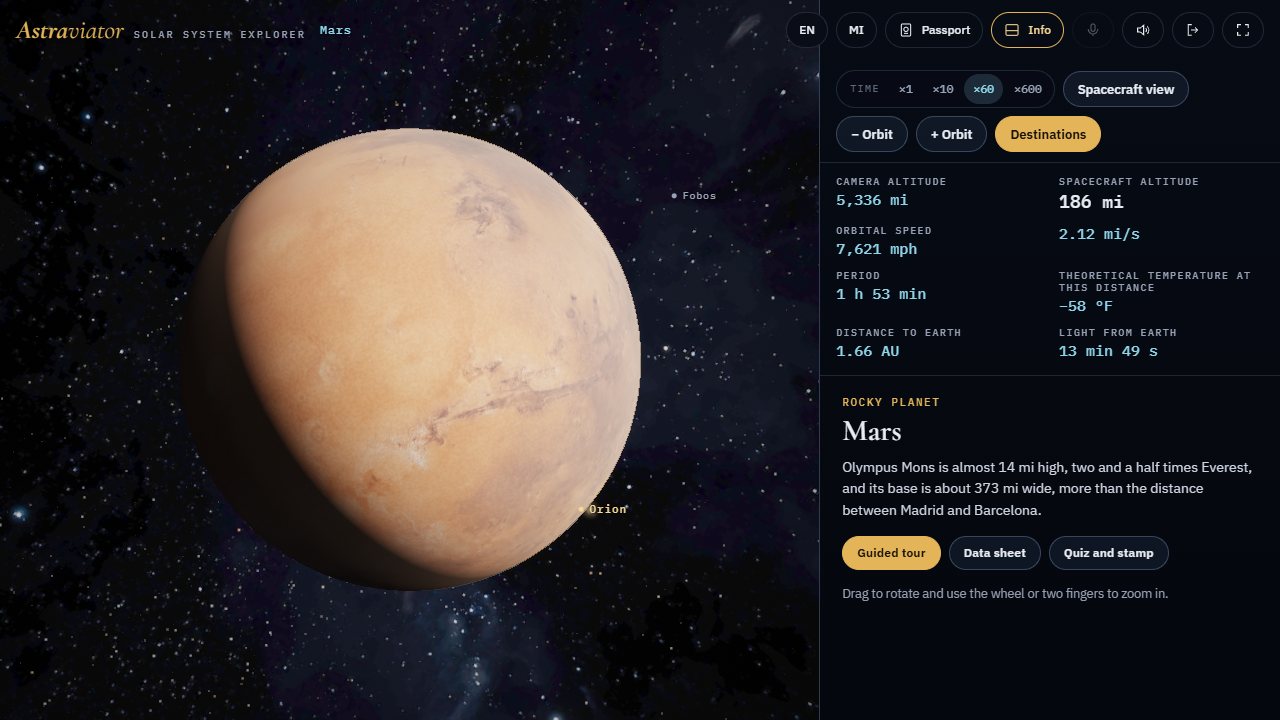
- Mars: a bit more than a third. You would feel light and springy, but not as floaty as on the Moon.
- Jupiter: about two and a half times stronger. Standing up would be hard work, and a 60 pound kid would feel like a 150 pound adult.
Why are astronauts “weightless” on the space station?
A common surprise: at the height of the International Space Station (about 250 miles up) gravity is still around 90% as strong as on the ground! Astronauts float because the station and everyone in it are falling around the Earth all the time, moving sideways so fast (about 17,500 miles per hour) that they keep missing the ground. That constant free fall feels like weightlessness.
Try the math yourself
Take your weight in pounds and multiply by the gravity number of each world. For an 80 pound kid on Mars: 80 × 0.38 = 30.4 pounds. The free worksheet has a table to fill in with your own weight.
Try it at home
What you need
- A bathroom scale (or your known weight)
- A calculator
- Pencil and the printable worksheet
Steps
- Step on the scale (ask a grown-up to help) and write down your weight in pounds.
- Multiply your weight by the gravity number of each world in the table above.
- Rank the worlds from lightest to heaviest. On which world would you weigh the most? The least?
- Challenge: make a “space jump” chart. If you can jump 1 foot on Earth, how high could you go on the Moon?
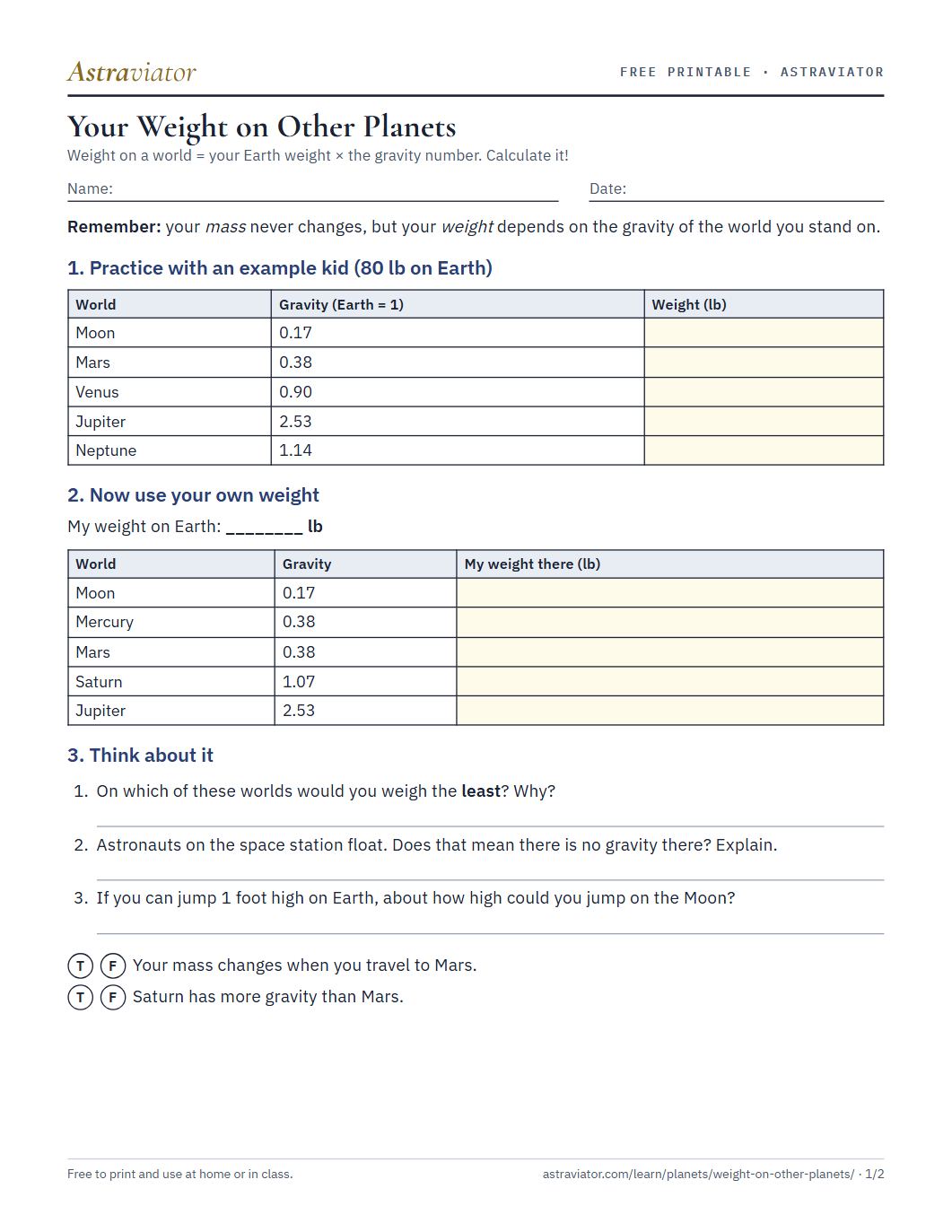
Free printable worksheet: Your Weight on Other Planets
Print it, solve it, check it with the answer key on page 2. No sign-up, no email needed.
Download the worksheet (PDF)PDF, 2 pages (worksheet + answer key), US Letter size.
Quick answers
Why do things weigh less on the Moon?
The Moon has much less mass than Earth, so its gravity is only about one sixth as strong.
Does my mass change on other planets?
No. Mass stays the same. Only weight changes, because weight is the pull of gravity on your mass.
Where would I weigh the most?
On Jupiter, among the planets: about two and a half times your Earth weight (at the cloud tops). On the Sun it would be nearly 28 times, but nobody can stand there.
Why do astronauts float in space?
They are in constant free fall around the Earth. Gravity is still pulling on them, but they and the spacecraft fall together, so they feel weightless.