The planets in order from the Sun, with facts for each
There are eight planets, and each one is special. Here they are in order from the closest to the Sun to the farthest, with the facts that teachers love to ask about.
Key facts
- Order: Mercury, Venus, Earth, Mars, Jupiter, Saturn, Uranus, Neptune.
- Venus is the hottest planet, hotter than Mercury.
- Jupiter is the biggest planet; Mercury is the smallest.
- Mars looks red because of rusty iron in its dust.
- Neptune is the farthest planet and has the fastest winds.
1. Mercury
The smallest planet and the closest to the Sun. A year on Mercury lasts only 88 Earth days. It has almost no air, so it is boiling hot in daylight (about 800 °F / 430 °C) and freezing at night (about −290 °F / −180 °C). It has no moons.
2. Venus
The hottest planet, around 900 °F (465 °C), because its thick clouds trap heat. It spins backward compared with most planets, and one day on Venus is longer than its year. It has no moons.
3. Earth
Our home and the only place known to have life. About 71% of its surface is water. It has one Moon. Earth turns once in about 24 hours and goes around the Sun in about 365 days.
4. Mars
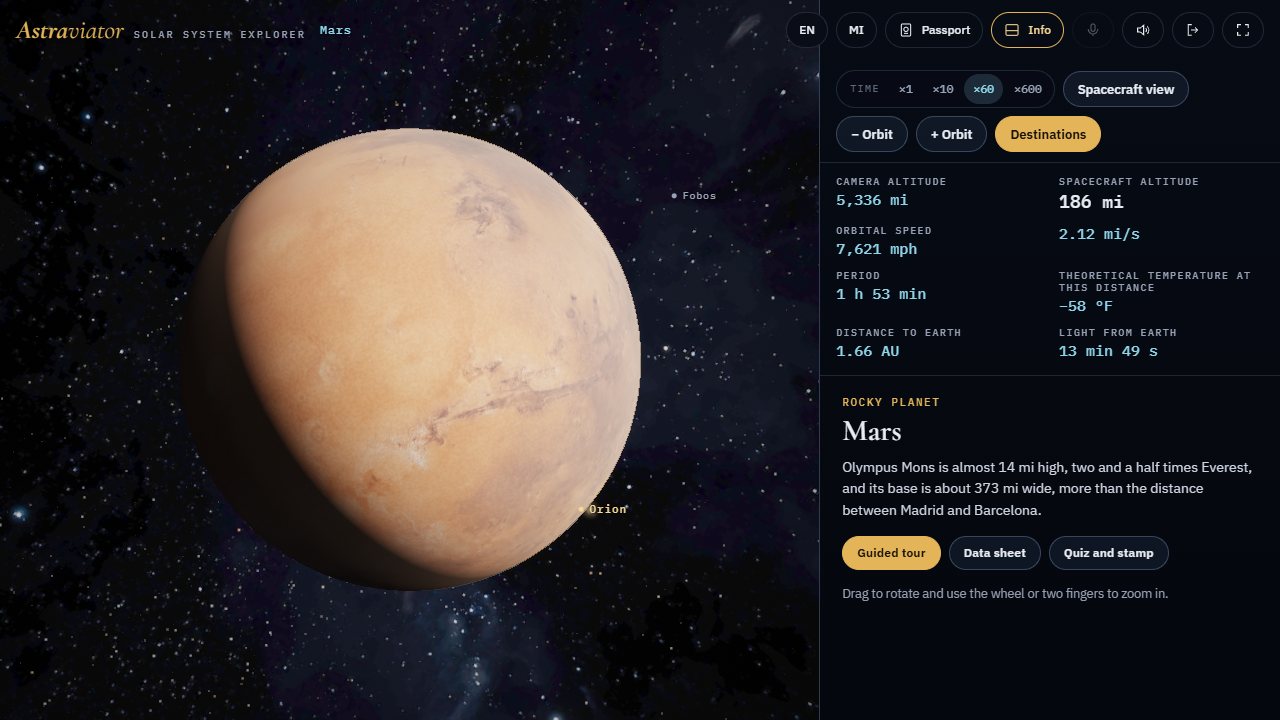
The Red Planet. Its dust contains iron oxide, which is rust, and that gives it the red color. It has the tallest volcano in the solar system, Olympus Mons, about 13.6 miles (22 km) high. It has two small moons, Phobos and Deimos. Robot rovers are exploring it now.
5. Jupiter
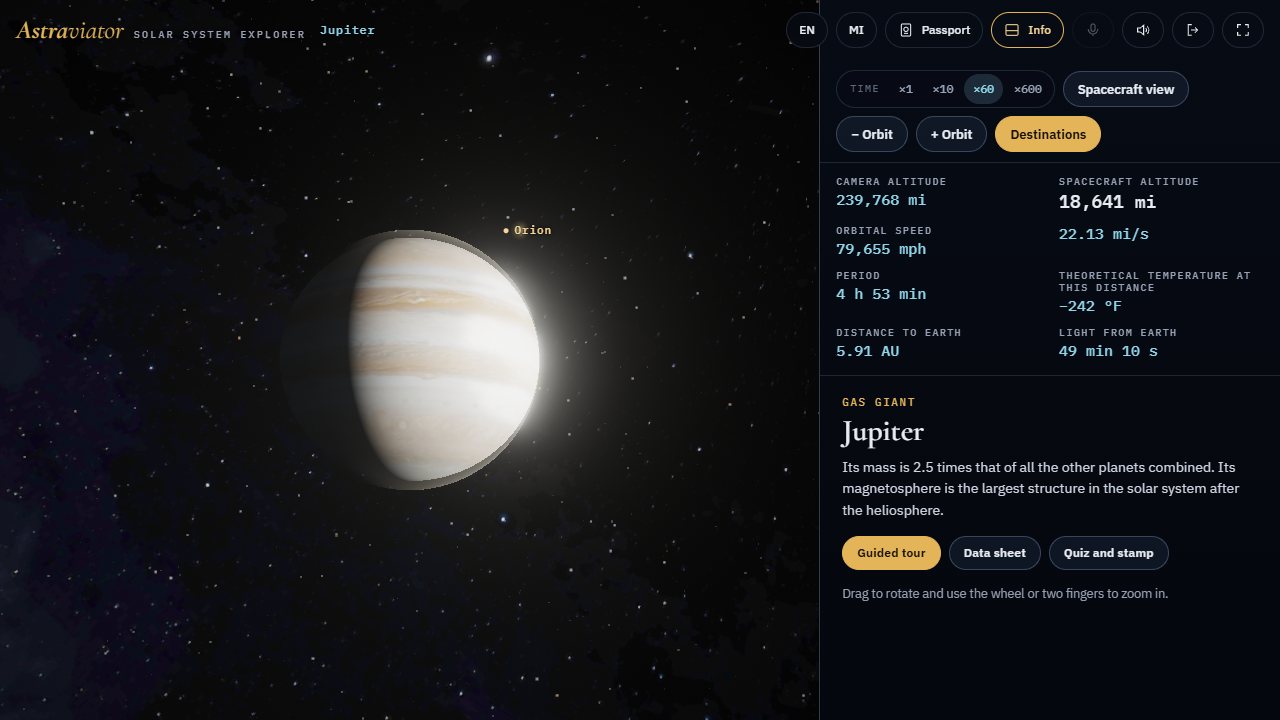
The biggest planet, a gas giant. Its Great Red Spot is a giant storm that has been seen for centuries and is wider than Earth. Jupiter spins faster than any other planet: a day lasts only about 10 hours. It has more than 90 known moons.
6. Saturn
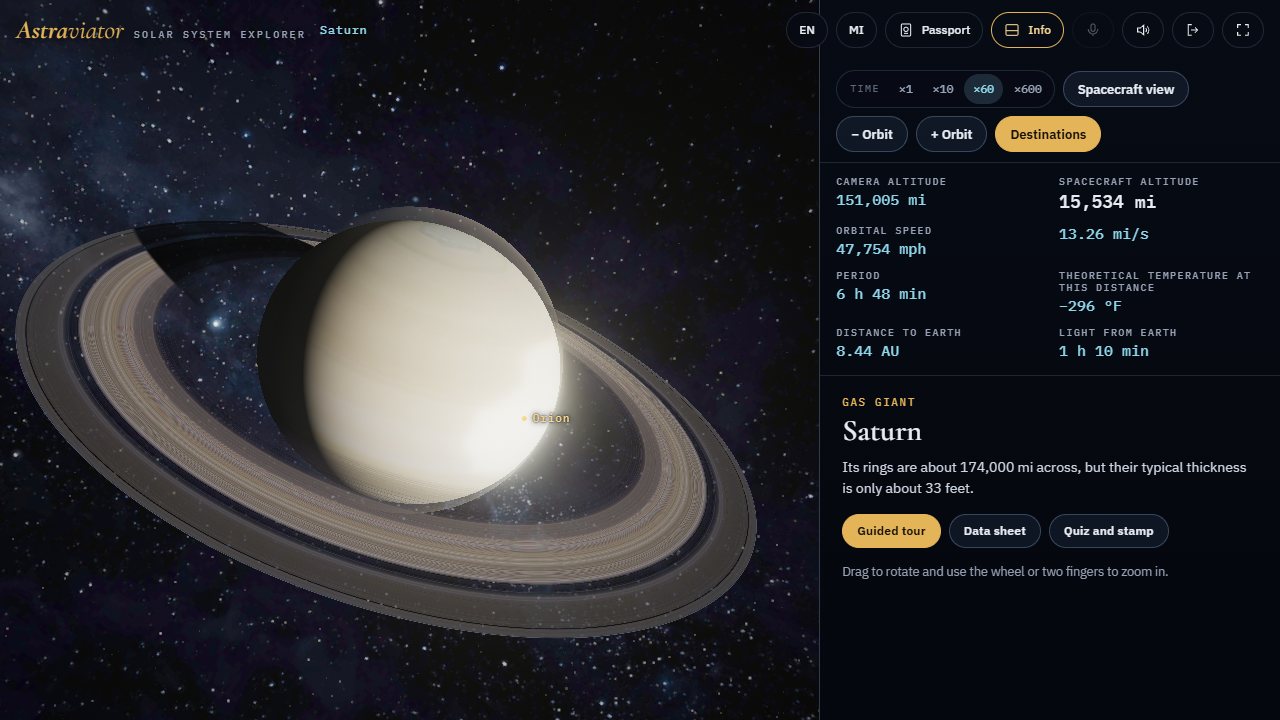
Famous for its rings, made mostly of pieces of water ice, from dust-sized grains to chunks as big as houses. It is so light for its size that it would float in water, if there were a bathtub big enough. It has well over 100 known moons.
7. Uranus
An ice giant that spins tilted on its side, like a rolling ball. One year lasts 84 Earth years. Its atmosphere is the coldest of any planet, about −371 °F (−224 °C). It looks blue-green because of methane gas.
8. Neptune
The farthest planet, a dark blue ice giant. It has the fastest winds in the solar system, up to about 1,200 miles per hour (2,000 km/h). Neptune was found in 1846 by using math to predict where it had to be. One year lasts 165 Earth years.
Quick comparison
| Planet | Distance from the Sun | Diameter | One year |
|---|---|---|---|
| Mercury | 36.0 million miles | 3,032 miles | 88 Earth days |
| Venus | 67.2 million miles | 7,521 miles | 225 Earth days |
| Earth | 93.0 million miles | 7,918 miles | 365 days |
| Mars | 142 million miles | 4,212 miles | 687 Earth days |
| Jupiter | 484 million miles | 86,880 miles | 11.9 Earth years |
| Saturn | 891 million miles | 72,365 miles | 29.5 Earth years |
| Uranus | 1,784 million miles | 31,518 miles | 84 Earth years |
| Neptune | 2,793 million miles | 30,599 miles | 165 Earth years |
A sentence to remember the order
My Very Educated Mother Just Served Us Nachos.
Try it at home
What you need
- 8 index cards or pieces of paper
- Markers
- A string or a hallway
Steps
- Write one planet on each card, with one fact on the back.
- Shuffle the cards, then put them in order from the Sun without looking at your notes.
- Quiz a friend: show the fact, they guess the planet.
- Which planet is your favorite? Write three reasons.
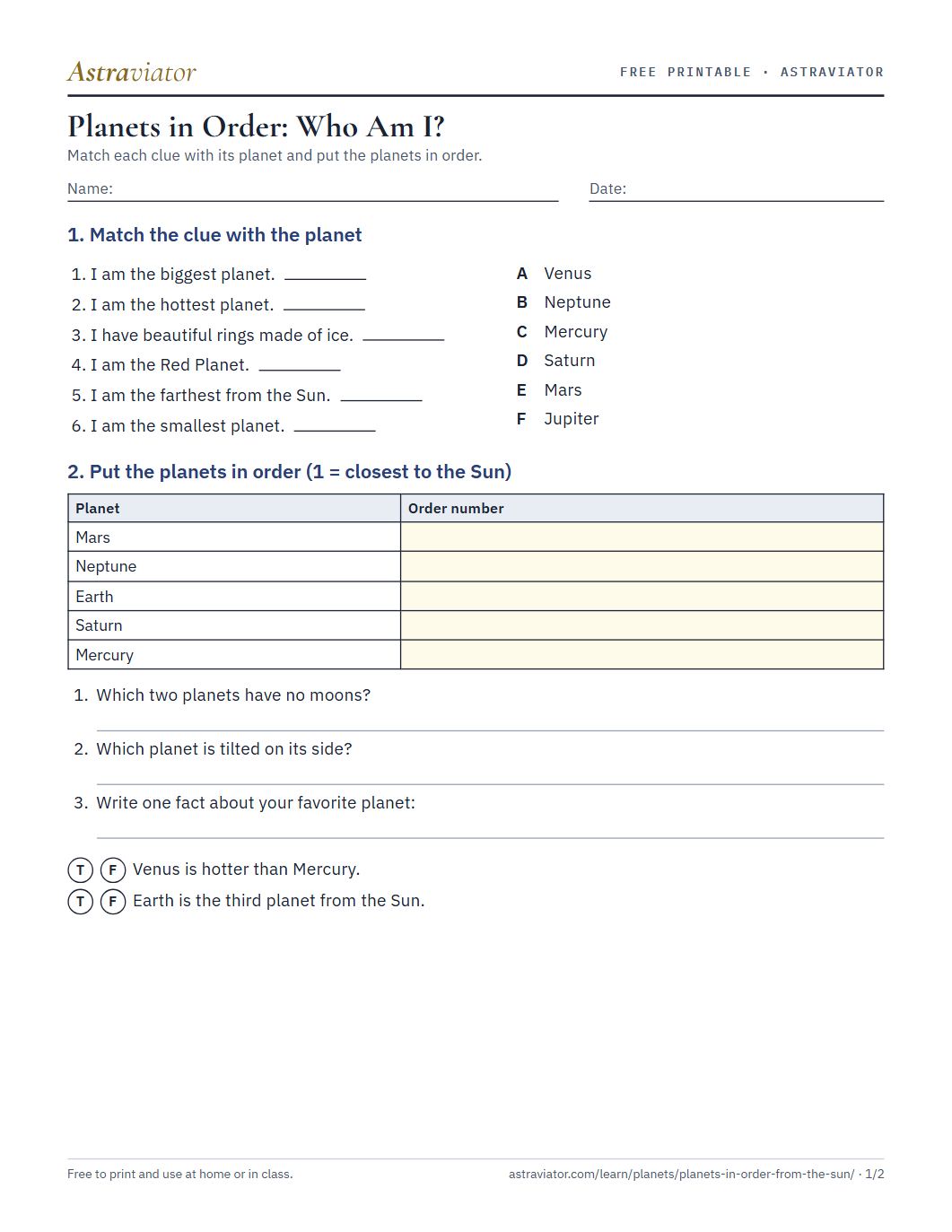
Free printable worksheet: Planets in Order: Who Am I?
Print it, solve it, check it with the answer key on page 2. No sign-up, no email needed.
Download the worksheet (PDF)PDF, 2 pages (worksheet + answer key), US Letter size.
Quick answers
What is the order of the planets?
Mercury, Venus, Earth, Mars, Jupiter, Saturn, Uranus, Neptune.
Which planet is closest to the Sun?
Mercury.
Which planet is the hottest?
Venus, because its thick atmosphere traps heat.
Which planet has the most moons?
Saturn has the most known moons, followed by Jupiter. The number grows as astronomers discover new small moons.